Is Your Business Future Ready?
Over the past few years, working with leadership teams and businesses across New Zealand, Australia and Europe, I’ve noticed a consistent pattern.
Most organisations are still focused on the immediate AI question:
How can we use AI to save time and improve productivity today?
That matters. In fact, it is where many of the fastest gains are coming from.
But I think there is a bigger question emerging behind it.
What happens to your business when intelligence itself becomes cheap?
That is the question I believe more leadership teams need to start asking now.
The businesses that will be hardest to compete with over the next few years will not simply be using AI to write emails faster, summarise meetings or draft reports.
They will be redesigning how work gets done on the assumption that capable digital intelligence is becoming cheaper, more abundant and easier to access.
And some of the most disruptive competitors may not be established firms at all.
They may be start-ups designed from day one around AI, agents and automation, without legacy systems, legacy structures or assumptions about how many people a business should need.
Most established businesses are managing today. The best are also preparing for what comes next.
Intelligence is becoming a commodity
For most of modern business history, cognitive capability has been scarce.
If you wanted more analysis, research, writing, software development, financial modelling, legal work or customer support, you generally needed more skilled human time.
Expertise was expensive because people were expensive, and expertise took years to build.
AI is starting to change that relationship.
In the work I do with businesses, I’m already seeing teams use AI to research faster, analyse large amounts of information, prepare proposals, draft communications, review documents, create first-pass reports and support decisions.
The important shift is not simply that AI is getting better.
It is that the cost of accessing useful cognitive capability is falling very quickly.
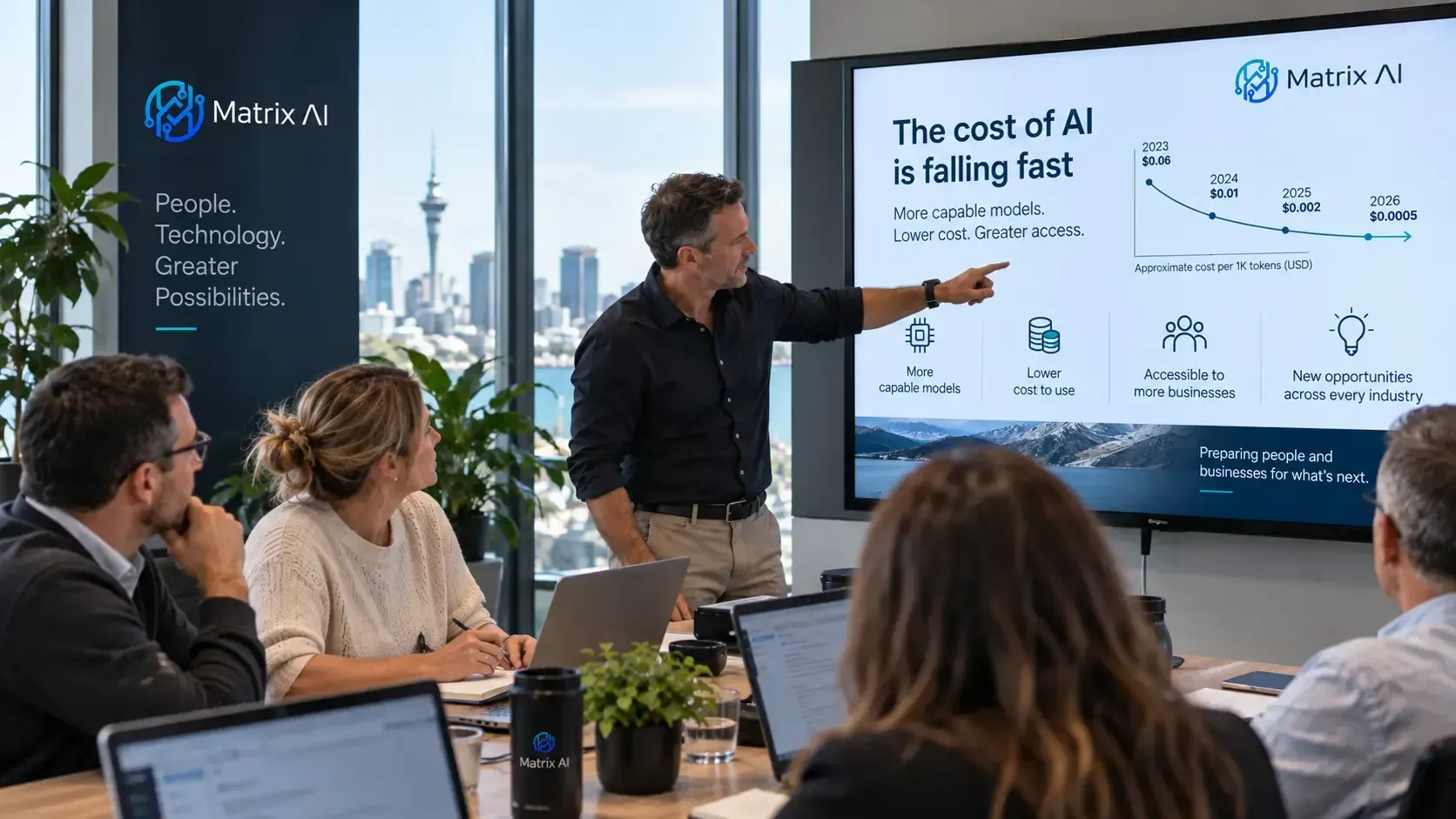
Research referenced in our Future of Work work shows just how significant this is. The cost of accessing a broadly comparable level of model capability has fallen by orders of magnitude in only a few years.
But the exact cost per token is not what matters most to a CEO or board.
What matters is the cost of completing a useful unit of cognitive work.
Researching a market. Reviewing a contract. Preparing a proposal. Analysing customer feedback. Writing software. Reconciling transactions. Producing a first-pass financial analysis.
If the same business outcome can be produced with significantly less human effort, the economics of knowledge work start to change.
Which activities in your business are still expensive primarily because they consume skilled human cognitive time?
The falling cost of intelligence changes what businesses compete on
One thing I see regularly is organisations getting excited because they have rolled out Copilot, ChatGPT or another AI platform.
That is useful.
But it is not a competitive advantage.
Your competitors can buy the same tools and access many of the same models.
Increasingly, they can also choose between premium frontier models, lower-cost specialist models and open-weight alternatives depending on the work they are trying to do.
The model layer itself is becoming more competitive.
Proprietary data, institutional knowledge, customer relationships, trusted brands, workflow design, judgement and execution.
When the underlying intelligence becomes easier to rent, the value shifts to what you combine it with.
That means simply “having AI” will not be a moat.
China is accelerating this shift
Another development I think many businesses in our part of the world are underestimating is the pace of AI development coming from China.
Chinese developers including Alibaba, DeepSeek, Moonshot AI and Z.ai are contributing to a much more competitive global model ecosystem.
The important issue is not whether one Chinese model beats one American model on a benchmark this month.
Those rankings will continue to move.
What matters is that competition is increasing across capability, cost and deployment flexibility.
A premium model might be used for difficult reasoning. A lower-cost model may handle high-volume routine work. An open-weight model may make sense where customisation, control or sovereignty matters.
That competition should continue putting pressure on the underlying cost of intelligence.
It also introduces another issue that will become increasingly important for larger organisations: AI sovereignty.
For governments, banks, healthcare organisations, critical infrastructure operators and businesses handling sensitive information, where AI runs may become almost as important as what it can do.
The model matters less over time. What you build around it matters more.
Cheaper intelligence does not automatically mean higher productivity
This is an important reality check.
In client discussions, I often see an assumption that because AI is powerful, productivity gains will automatically follow.
They do not.
One peer-reviewed customer-service study involving more than 5,000 workers found AI assistance improved productivity by around 15% on average, with the largest gains among less experienced workers.
Yet a separate randomised study of experienced open-source developers found the AI tools being tested actually made participants around 19% slower in that particular setting.
Both results can be true.
Different work. Different users. Different tools. Different processes.
AI productivity is a workflow-design problem, not a software-licensing problem.
Buying the technology is the easy part.
Redesigning the work is where the value is created.
The future organisation may allocate tasks, not jobs
Most organisations are still structured around roles.
People have titles. Roles have responsibilities. Work moves from one person to another.
That will not disappear overnight, but I expect it to become less useful as the primary way of thinking about work.
A different operating model is emerging where tasks can increasingly be allocated across combinations of humans, models, software and agents.
Some work will remain human-owned.
Some will be AI-executed.
Much of it will be hybrid.
Which parts of this workflow should be automated, which should be augmented, which should stay human, and which should disappear altogether?
That is a much more practical way to think about the future of work.
It is also where disruptive start-ups have an advantage.
An established organisation often tries to insert AI into an existing process.
A new company can start by assuming routine cognitive work should be automated from the outset.
Human value does not disappear. It moves.

In conversations with executives, one concern comes up repeatedly:
Where do people fit?
I think the answer is more encouraging — and more challenging — than many expect.
Human value does not simply disappear.
It moves.
And in high-trust environments, relationships still matter.
An AI model may know almost everything publicly available about your industry.
It does not automatically know why your largest customer nearly left two years ago.
It does not know which executive will resist a change, which risk your board will accept, or which option is commercially and culturally realistic inside your organisation.
That context is valuable.
The overlooked risk: who becomes the expert of tomorrow?
This is one of the issues I think more boards and leadership teams should be discussing.
Many of the tasks AI is best suited to are the same tasks junior employees have traditionally done:
- research
- first drafts
- basic analysis
- document review
- routine coding
- standard customer interactions
These tasks are not always glamorous.
But they are often how people learn.
Emerging labour-market evidence is already raising questions about reduced hiring among younger workers in highly AI-exposed occupations.
If AI does the junior work, how do you create the senior adviser, engineer, accountant, lawyer or manager of 2035?
Businesses cannot simply automate entry-level work and assume capability development will somehow take care of itself.
Apprenticeship models will need to change.
Junior employees may need earlier exposure to reviewing AI outputs, handling exceptions, working directly with customers, participating in simulations, shadowing experienced staff and learning why an AI answer is right or wrong.
The organisation that automates junior work without redesigning professional development may discover later that it has excellent AI tools, but too few experienced people capable of supervising them.
Human oversight should not mean human approval of everything
Another pattern I see is governance discussions becoming too binary.
Either AI is tightly controlled, or it is allowed to operate freely.
Neither extreme is particularly useful.
A better principle is variable autonomy.
The more ambiguous, consequential, irreversible or human-sensitive the decision, the stronger the human role should be.
A low-risk internal classification task may eventually be highly automated.
A decision involving employment, insurance, healthcare, lending or safety should have much stronger human review.
The aim is not maximum automation.
It is appropriate automation.
This becomes even more important as we move from chatbots to agents.
A chatbot produces text.
An agent can potentially retrieve information, modify records, send communications, interact with systems and execute transactions.
Not just: “What can this model say?”
But: “What is this system allowed to do?”
Professional services should pay particular attention
This is an area where I think the business-model implications are particularly significant.
Many professional-services businesses still effectively sell human cognitive labour by the hour.
Consulting. Accounting. Legal services. Marketing. Technology. Research.
If the amount of human effort required to produce an acceptable outcome falls materially, that creates pressure on firms whose economics depend primarily on selling that effort.
Work that historically required ten hours of research and analysis may increasingly be delivered through two hours of expert judgement combined with AI-assisted research, analysis and production.
Trying to protect the ten-hour process is unlikely to be a long-term strategy.
Outcomes. Judgement. Proprietary methods. Assurance. Implementation. Sector expertise. Relationships. Accountability.
AI can reduce the time required to produce the work.
The commercial question is whether the business simply lowers its price — or uses that leverage to create substantially more value.
AGI matters, but I would not build a strategy around a date
Artificial general intelligence is attracting enormous attention.
In workshops and executive conversations, it is coming up more frequently.
The problem is that there is no universally agreed definition and forecasts about when, or even precisely how, AGI might emerge vary enormously.
So I would not recommend building a strategy around “AGI arrives in 2027” or any other particular year.
A better approach is to use AGI as a strategic stress test.
- What happens if AI becomes another ten times cheaper?
- What if agents can reliably complete work that currently takes an employee a day?
- What if AI can complete multi-day digital workflows with little supervision?
- What if a competitor launches a similar service with one-tenth of your current operating cost?
- What if customers can reproduce part of what you currently sell themselves?
These are useful strategic questions regardless of whether anyone formally declares that AGI has arrived.
Businesses need two AI agendas
This is probably the biggest lesson I am taking from working with businesses right now.
Leadership teams need to operate on two horizons at the same time.
1. Improve the business you have today
Where can AI save time? Improve quality? Reduce administration? Improve customer experience? Speed up decisions? Generate measurable ROI?
Businesses absolutely need to capture those gains.
2. Prepare the business you may need tomorrow
What does your organisation need to become if intelligence continues getting cheaper and more autonomous?
That question is harder.
It is also the question many organisations postpone because today’s operational priorities always feel more urgent.
Meanwhile, someone else is designing for that future.
A competitor. A technology platform. A start-up.
Someone without your existing processes, systems or cost structure.
Improve the organisation you have today while deliberately preparing the organisation you may need tomorrow.
What I would recommend leaders do now
That last question often leads to the most interesting leadership conversations.
The real competitive question
The future of work is often framed as a contest between humans and machines.
I think that misses the more important transition.
We are moving from a world in which capable intelligence was scarce and expensive towards one in which increasingly sophisticated digital intelligence is abundant and cheap.
That will not make human beings irrelevant.
But it will change where the premium sits.
When intelligence becomes cheap, the premium shifts to knowing what to do with it.
The organisations that do well in this environment will not necessarily have the smartest AI.
They will be the ones that combine machine intelligence with something their competitors cannot easily rent:
Their knowledge. Their customer relationships. Their data. Their judgement. Their brand. Their people. Their execution capability.
And, critically, their ability to redesign themselves before they are forced to.
Most businesses I work with are understandably focused on the here and now.
They should be.
But the better ones are also starting to look beyond it.
And the organisations I would be watching most closely are the ones that do not have to unlearn the past at all.
They are building for the future from day one.
Is your business preparing for the next phase of AI?
Matrix AI works with leadership teams and organisations across New Zealand, Australia and internationally to identify where AI can create value today — while preparing for how AI, agents and increasingly autonomous systems may reshape the business in the years ahead.
Our work includes AI strategy and roadmaps, AI governance, AI workshops and workforce enablement, and executive conversations on the future of AI and work.
The goal is not simply to deploy more AI. It is to help your organisation make better decisions about where AI genuinely creates value — and build the capability to adapt as the technology develops.
Talk to Matrix AISources and further reading
Stanford Institute for Human-Centered AI – AI Index
Research on AI capability, adoption, model economics and falling inference costs.
Stanford AI Index
International Labour Organization – Generative AI and Jobs: A 2025 Update
Research on occupational exposure to generative AI and why job transformation is currently more plausible than wholesale replacement.
ILO: Generative AI and Jobs
METR – Measuring AI Ability to Complete Long Tasks
Research tracking how the duration of tasks frontier AI agents can complete autonomously has been changing over time.
METR: Measuring AI Ability to Complete Long Tasks