AI in the Workplace: Change Management Is Key
AI in the Workplace: Why Change Management Will Decide Who Gets the Value
The biggest AI risk for most Australian and New Zealand businesses is no longer failing to adopt the technology.
It is failing to prepare people for what the technology changes.
I have spent more than 25 years working around disruptive technology. The pattern is remarkably consistent.
Buy the technology. Announce the transformation. Train a few people. Assume the workforce will follow.
They rarely do.
AI makes that mistake more expensive because employees are often already using the technology before the organisation has decided how it wants them to use it.
That is why AI in the workplace is fundamentally a change-management issue, not simply a technology deployment.
The organisations that get this right will not necessarily be those with the most AI licences.
They will be the ones that help people understand what is changing, give them a reason to participate, build practical capability early and redesign work around what AI can now do.
The workforce is already changing
I would not start a board conversation with predictions of mass unemployment.
The evidence is more nuanced — and more useful.
The International Labour Organization estimates that around one in four workers globally are in occupations with some exposure to generative AI, rising to around 34% in high-income countries.
Importantly, its conclusion is not that one in four jobs disappear.
The ILO expects transformation to be more common than wholesale replacement because most occupations still contain tasks requiring human input and judgement.
Exposure is not redundancy.
But exposure does mean change.
The local skills market is already showing it.
PwC's 2026 New Zealand jobs research found AI-related job advertisements increased from around 3,900 in 2024 to around 9,600 in 2025. It also found significant growth in the number of skills being requested in occupations highly exposed to AI.
The message for CEOs and HR leaders is not that AI is about to eliminate the workforce. It is that the content of work is changing rapidly.
Some tasks will disappear.
Others will become easier.
Some roles will become more valuable.
And entirely new expectations will develop around what an employee should be able to achieve with AI.
That is an AI workforce transformation, whether the organisation formally calls it one or not.
We have seen this before — but AI is different
The most useful historical comparison is electricity.
Electricity was a general-purpose technology capable of transforming almost every industry.
But installing an electric motor did not suddenly make a factory dramatically more productive.
Early factories often replaced the steam engine with an electric motor while leaving the factory layout and work processes essentially unchanged.
The bigger productivity gains came later, when organisations redesigned factories around electricity: smaller motors, different layouts, different workflows and different responsibilities for workers.
The technology mattered.
Organisational redesign mattered more.
There is an obvious parallel with AI.
Installing Microsoft Copilot on an unchanged business process is the modern equivalent of replacing the steam engine with an electric motor and leaving everything else untouched.
It looks like transformation.
It may not move the P&L.
The real value comes when organisations begin redesigning workflows around the new capability.
But AI differs from previous technological shifts in several important ways.
First, it spreads as software.
A steam engine required a factory. AI can require little more than an account and a browser.
Second, it reaches cognitive work.
Drafting, analysis, summarisation, research, classification, scheduling and first-line advice are now all affected. This is work carried out by managers, professionals and administrators, not just production workers.
Third, there is no obvious finish line.
A factory electrification programme eventually ended.
AI models keep improving.
Capabilities change every few months.
New agents, models and workflows continually create another round of organisational change.
That means businesses need something more valuable than an AI implementation plan. They need the organisational capability to keep changing.
Most AI programmes start in the wrong place
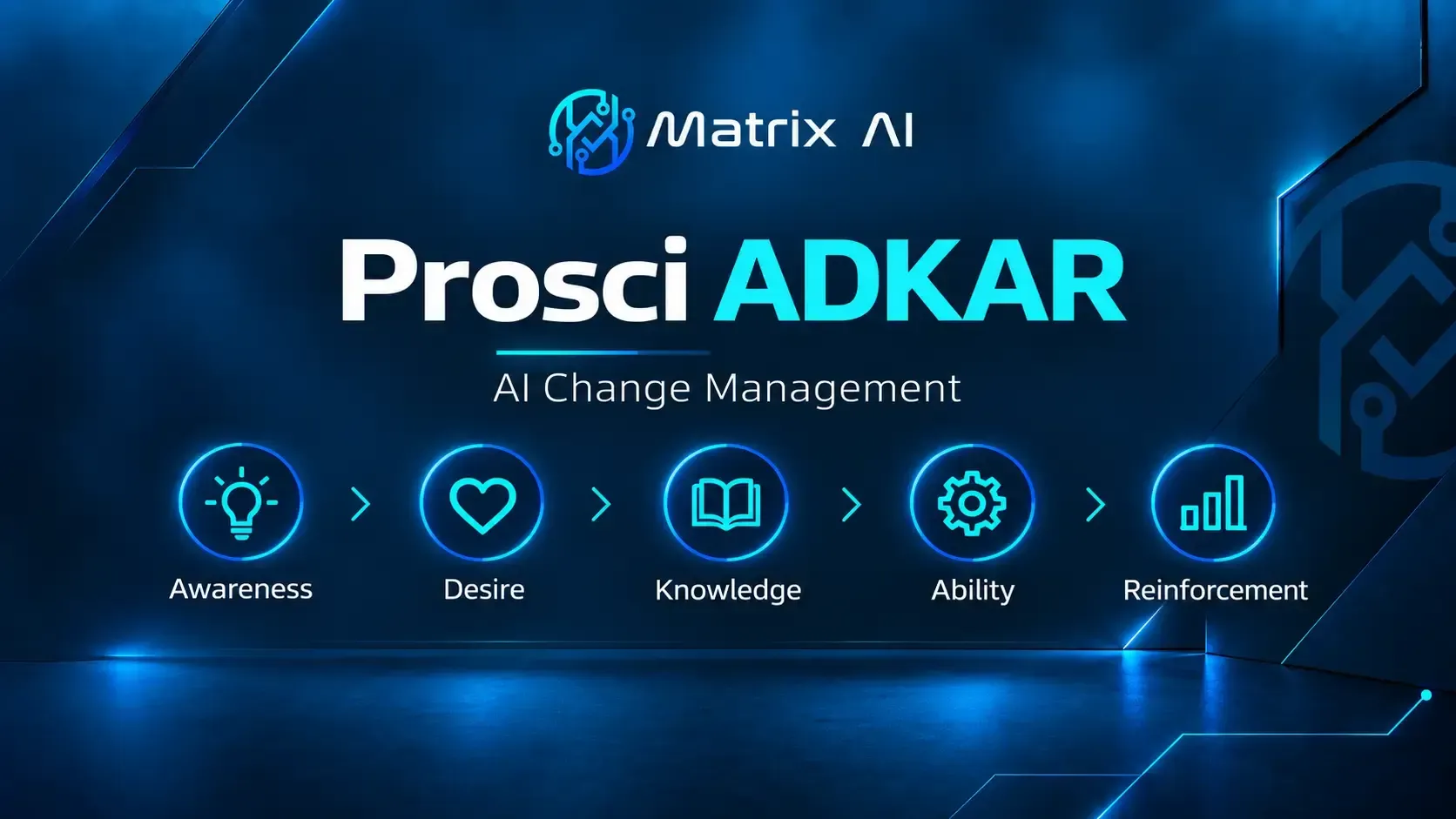
This is one reason I find the Prosci approach to change management useful. The Prosci ADKAR model describes individual change through five stages:
Awareness → Desire → Knowledge → Ability → Reinforcement
It looks simple.
But it exposes one of the biggest mistakes I see in AI adoption.
Most organisations start at Knowledge.
Here is your Copilot licence.
Here is your prompt guide.
Here is the training session.
Then usage plateaus and leadership concludes that employees are resistant to AI.
Often, the problem began much earlier.
Sponsorship: the factor I would fix first
Prosci places significant emphasis on active and visible sponsorship, and this strongly reflects my own experience.
I would go further.
If an AI transformation does not have a credible senior sponsor, there is a good chance it becomes an afterthought.
It gets delegated to IT.
Or L&D.
Or an innovation team.
People attend a workshop, use the tool occasionally, and return to whatever their manager actually measures them on.
A sponsor cannot simply approve the budget.
The sponsor has to make the change matter.
That means visibly using AI themselves.
Talking about it with the leadership team.
Explaining why the organisation is changing.
Removing barriers.
Giving managers permission to redesign work.
Holding leaders accountable for adoption.
And continuing to reinforce the programme after the launch communication has disappeared.
Employees are very good at identifying the difference between a CEO saying:
"AI is strategically important."
and a CEO actually changing how the organisation operates because of it.
When the sponsor treats AI as optional, the organisation will too.
Awareness: explain what is changing
People need to understand the reason for the change before they are asked to embrace it.
Not a generic message about becoming "AI enabled".
Why is this workflow changing?
Why now?
What problem are we trying to solve?
What will AI do?
What remains a human responsibility?
And what do we genuinely not know yet?
A clear message from a respected sponsor is more powerful than a large transformation deck.
Credibility matters particularly because employees are hearing radically different predictions about AI outside work.
Some are excited.
Some are worried about their jobs.
Others have tried ChatGPT once, received a poor answer and decided the technology is overhyped.
Good AI change management begins by making the change understandable.
Desire: people need a reason to participate
Awareness is not desire.
An employee can understand exactly why the company wants AI and still see no personal reason to embrace it.
"Twenty per cent productivity improvement" sounds attractive in a board paper.
To an employee, it can sound like:
"What happens when we need twenty per cent fewer people?"
Leaders need to acknowledge this rather than hiding behind vague statements about innovation.
Show people what improves for them.
Which repetitive task disappears?
Which administrative burden gets smaller?
Where can AI remove frustration?
Where can employees spend more time on customers, judgement, creativity or higher-value work?
I would also involve teams in identifying what should be automated first.
People are much more likely to support AI when they have some agency over how it changes their work.
Knowledge: train people earlier, not later
This is where I differ from organisations that want to complete the strategy, policy and governance frameworks before they let employees near the tools.
You need appropriate governance.
But waiting too long to build capability can itself increase resistance.
In my experience, getting employees using approved tools such as Microsoft Copilot or ChatGPT early in the programme is one of the best ways to build momentum.
Practical training changes the conversation.
AI stops being something happening to the workforce and becomes something employees can actually use.
They discover that it can draft the first version of a document.
Summarise a long meeting.
Help structure an analysis.
Turn notes into an action plan.
Improve a difficult email.
Or remove twenty minutes from a task they dislike doing.
Those small wins matter.
They create confidence.
They generate internal examples.
They uncover use cases leadership would never have identified from the boardroom.
They also reduce some of the psychological resistance to change because the technology becomes familiar rather than abstract.
But training needs to be role-specific.
Finance, HR, marketing, customer service and engineering teams should not receive identical AI training.
And governance should be built into the learning.
Employees need to know:
- what information can be entered into the tool
- what cannot
- which platforms are approved
- what outputs need checking
- where human judgement remains mandatory
- when AI is simply the wrong tool
Training and governance should reinforce each other rather than operate as separate programmes.
Ability: a workshop is not adoption
Prosci makes an important distinction between knowing how to do something and being able to do it.
This distinction matters enormously with AI.
A two-hour workshop can create Knowledge.
It does not automatically create Ability.
Ability requires practice.
Employees need an approved tool, real work to apply it to, feedback and time.
That last point is frequently overlooked.
An employee can attend excellent Copilot training and return to a diary containing eight hours of normal work.
AI experimentation becomes something they are expected to do in addition to their job.
Then leadership wonders why adoption stalls.
I would rather see a team genuinely redesign three workflows than complete twenty hours of generic AI training.
Training without practice is an activity. It is not transformation.
Reinforcement: measure the work, not the login
The final ADKAR stage is where AI adoption often quietly dies.
A licence was issued.
Training happened.
Usage increased for several weeks.
Then attention moved elsewhere.
Reinforcement requires leaders to keep making the new way of working worthwhile.
Do not simply measure how many people logged into Copilot.
Measure what changed.
Did cycle time fall?
Was less rework required?
Did quality improve?
Did a manual step disappear?
Did the employee continue using the workflow after three months?
Did customers experience a better result?
Recognition matters as well.
Share useful employee examples.
Celebrate better workflows.
Let teams learn from one another.
And keep updating capability as the technology changes.
AI adoption is not a one-off implementation. It is an ongoing organisational capability.
Companies have a responsibility to bring people through the change
I would not describe this as a new statutory obligation.
I see it as a leadership responsibility.
If an organisation introduces technology that materially changes how people perform their jobs, leadership owns the transition.
There are three reasons.
Motivation
A workforce can quickly divide into two groups.
Those experimenting with AI and building capability.
And those avoiding it and becoming increasingly anxious about what it means for them.
That gap becomes harder to close over time.
Businesses should help more employees gain practical experience rather than allow a small group of enthusiastic users to pull away from everyone else.
Governance
Weak governance does not necessarily make employees cautious.
It often produces two equally poor behaviours.
Responsible employees stop using AI because they are afraid of breaking the rules.
Less cautious employees use personal tools and paste company information into them anyway.
Neither is a sensible AI strategy.
Good governance should create safe permission to experiment.
Approved tools.
Clear boundaries.
Human accountability.
Simple escalation routes.
And enough freedom for employees to discover genuinely useful applications.
Growth
The longer-term question is not simply which jobs AI might replace.
It is which tasks disappear and what capabilities people will need instead.
There is another issue leaders should consider.
Many junior employees learn by doing relatively routine work.
AI may increasingly perform that work.
If organisations automate the apprenticeship work without redesigning the apprenticeship, they risk weakening the pipeline that produces future specialists, managers and leaders.
That makes workforce development part of AI strategy — not something HR deals with afterwards.
The companies that win will build change capability
The competitive advantage will not be having an AI licence.
Your competitor can buy the same licence tomorrow.
The advantage is building an organisation capable of changing how work gets done faster than competitors can.
For me, the strongest AI adoption programmes have several things in common:
- A visible executive sponsor.
- Early practical training.
- Clear governance that enables rather than blocks use.
- Real workflows rather than generic demonstrations.
- Managers who reinforce the change.
- Time for people to practise.
- Measurement based on business outcomes rather than licence utilisation.
There is an important qualification.
A change-management programme will not rescue a bad AI strategy.
It cannot compensate for dirty data.
It will not fix a technology being used for the wrong problem.
And an ADKAR workshop is not an ROI calculation.
You still need a sound business case.
But when the technology has a legitimate use case,
people and change determine whether the organisation actually captures the value.
What I would do now
For CEOs, CHROs and HR leaders looking at AI in the workplace, I would start with six things.
- Appoint a genuine executive sponsor. Not someone whose name appears on the steering committee — someone prepared to visibly lead the change.
- Choose real workflows. Start with work employees recognise and where improvement can be measured.
- Explain the bargain. Be clear about why productivity matters, what happens to time saved and what remains human.
- Train people early. Give employees practical experience with approved AI tools before resistance becomes entrenched.
- Give them time to practise. Capability develops through repeated use on real work.
- Reinforce what works. Share successes, redesign processes and measure actual business outcomes.
My view
AI in the workplace is sometimes described as another digital transformation.
I think that understates what is happening.
AI changes not only the technology people use, but potentially what constitutes valuable human work. That makes the transition deeply personal.
Employees will naturally ask:
- What happens to my role?
- What skills will matter?
- What should I delegate to AI?
- What am I still accountable for?
- And where do I fit in five years?
Companies cannot answer every one of those questions today. They should not pretend they can.
But they can give employees a credible way to navigate the change.
Strong sponsorship.
Clear communication.
Early experience with the technology.
Practical skills.
Good governance.
And repeated opportunities to redesign work as AI capabilities improve.
Steam changed production. Electricity changed the factory once businesses redesigned the factory around it. AI is already sitting on the employee's laptop and phone. Your people have already plugged it in.
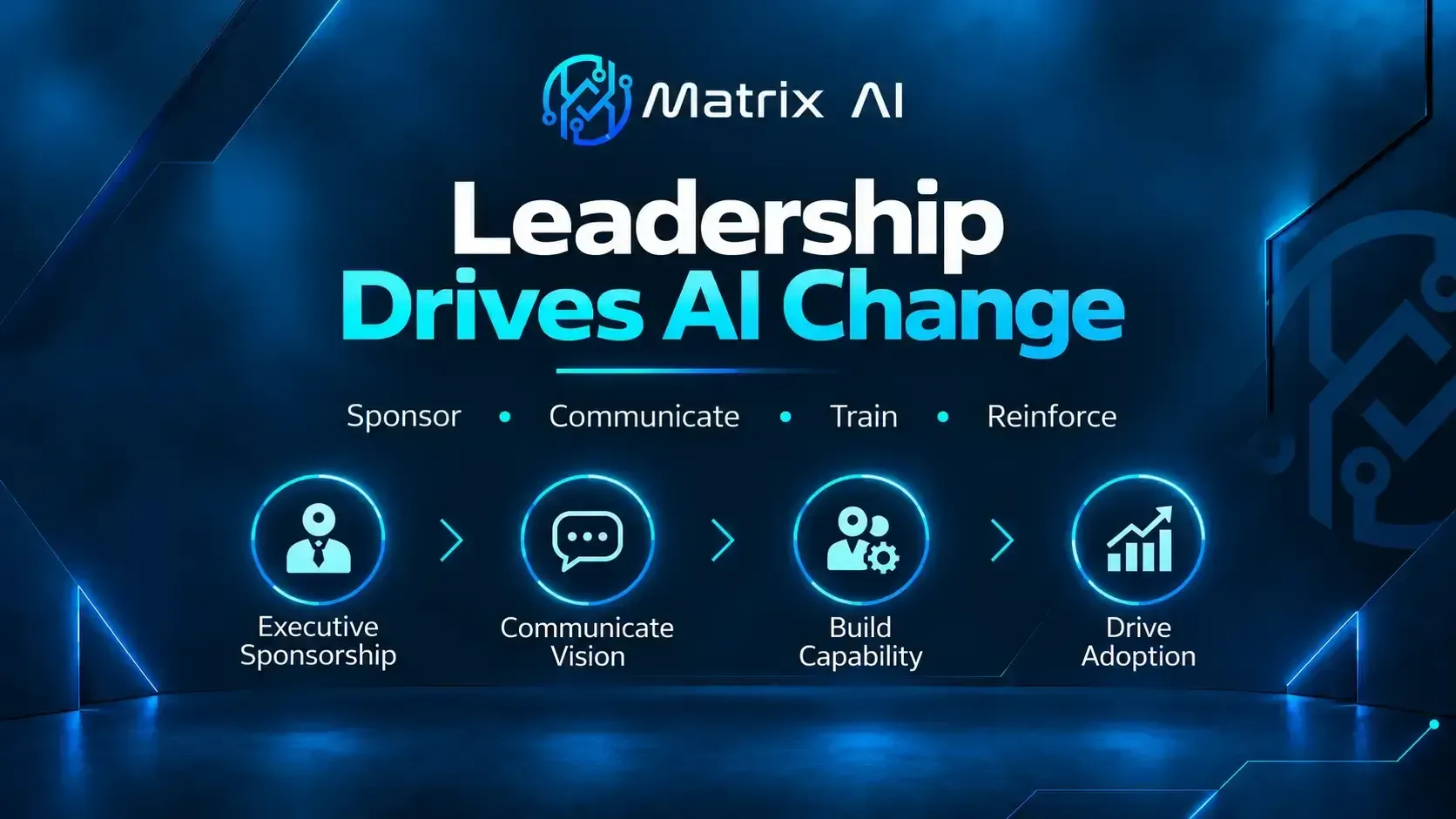
The real question is whether leadership will help people turn AI into a better way of working — with visible sponsorship, clear communication, practical training, safe guardrails and enough time to build real capability. That is what will determine whether AI becomes another underused technology rollout — or whether the organisation adapts fast enough to stay productive, competitive and relevant as the economics of work change.
Need to Prepare Your Organisation for AI in the Workplace?
Matrix AI helps businesses and government organisations across New Zealand and Australia prepare their people for AI-driven change — combining
AI change management,
strategy, governance, practical Copilot and ChatGPT capability-building, and workforce enablement. We help leadership teams move beyond licences and one-off training to build the sponsorship, skills, confidence and guardrails needed for AI adoption to stick — and for the organisation to stay productive, competitive and relevant as work changes.
AI BLOG